
- The 19 km Haryana stretch opened in March 2024; the Delhi section and the 5 km tunnel to IGI Terminal 3 followed in 2025, so the corridor is now operational end to end (Dwarka Expressway, Wikipedia).
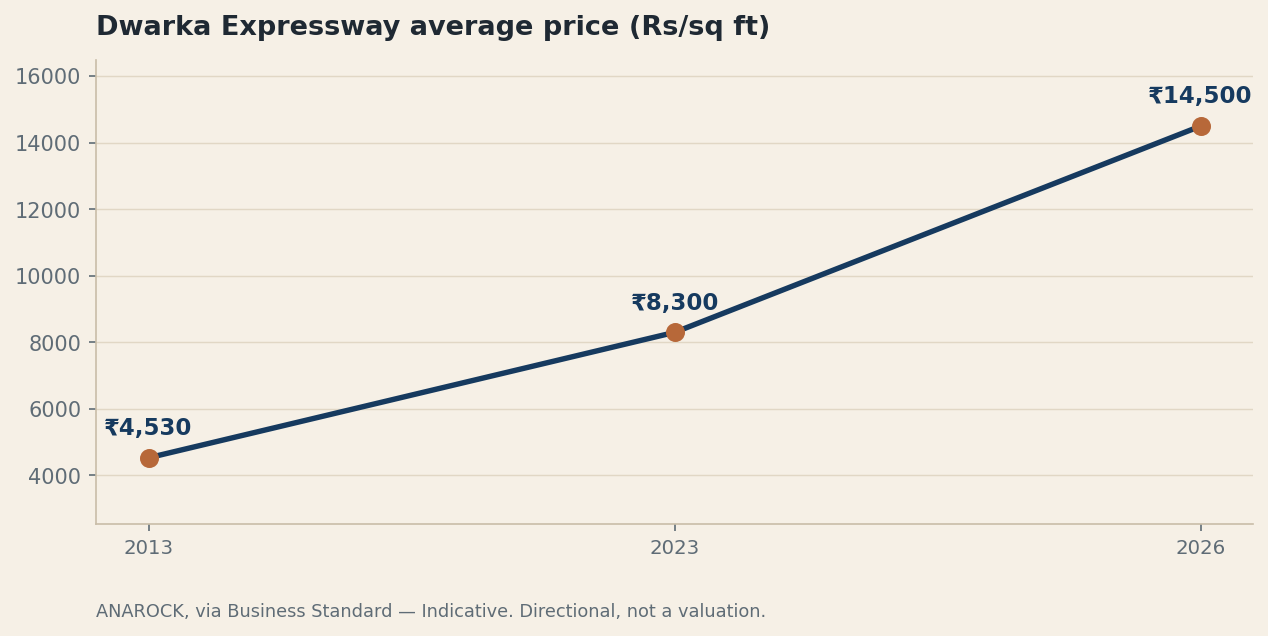
- Prices already re-rated through the build-out: ANAROCK pegs the decade move at +83%, from about ₹4,530 to ₹8,300 per sq ft between 2013 and 2023, with roughly 53,000 units launched and over 80% sold (Business Standard).
- Translation: connectivity is no longer a discount you capture. It is a premium you inherit.
For a buyer weighing ₹3-8 crore on the new sectors of the Dwarka Expressway, the road going live changed the question entirely. For a decade the pitch here was a promise — the Northern Peripheral Road would one day stitch these towers to the airport and to Delhi — and the price already assumed it. The asphalt has now arrived. The instinct is to read that as vindication and pay up. It is closer to the opposite: now that the spine is delivered, you can finally see which of the ribs — the drainage, the schools, the internal roads — are still drawings, and stop funding them at today's price.
The connectivity premium is already in the price
Start with what the corridor has done, because it disciplines everything else. ANAROCK's numbers, reported by Business Standard, put the average up 83% over the decade to 2023, and new launches in 2026 now quote ₹20,000-25,000 per sq ft against a resale market nearer ₹14,000-18,000 (99acres). The same firm forecasts another 20-40% over the next two to three years.
Read that honestly and it cuts against the easy bull case. A corridor that has already tripled off a connectivity story is not one where the connectivity story is still cheap. The road being open is not your entry signal — it is the proof that the entry signal was three years ago.
Sanctioned is a promise. Commissioned is an asset.
A master plan is a wonderful document and a terrible basis for a purchase. It shows sanctioned schools, sanctioned hospitals, sanctioned trunk drainage — none of which a resident can use. What a resident uses is what has been commissioned: the sewage line that is actually laid, the feeder that is actually energised, the internal road that actually drains in July. The premium you should pay tracks that second list. The first list is what the developer is asking you to fund in advance.
The Dwarka Expressway is now a study in that gap, because the spine is built while the ribs, sector by sector, are not.
A sector's price should track its commissioned infrastructure, not its master plan. The master plan is precisely the part you are being asked to pre-fund.
Sectors 102 to 113: what you are actually paying for
The corridor is not one market. The bands below are indicative ranges from listing aggregates in mid-2026 — a starting point, not a valuation — and the flagship projects are named to anchor each band, not as recommendations.
| Sector band | Indicative rate, mid-2026 | Flagship stock | The honest read |
|---|---|---|---|
| 102 / 106 | ~₹13,000-15,000 / sq ft | BPTP Verti Greens, Adani Oyster Grande | The value end. Real occupied inventory; you trade a few minutes of access for roughly 15-20% off the border sectors. |
| 103 / 104 | ~₹12,000-18,000 / sq ft | Godrej Vriksha, Whiteland Westin | The "face" of the corridor — the deepest launch pipeline, the most choice, and the most marketing to see past. |
| 110 / 113 | ~₹15,000-18,000+ / sq ft | Smartworld One DXP, M3M Mansion, Tata La Vida | The priciest cluster, first off the Delhi entry. You pay a position premium while some internal infrastructure is still maturing. |
Two sectors a kilometre apart can quote within touching distance on rate and mean entirely different things — a delivered, occupied neighbourhood versus a frontage and a hoarding. The asking price rarely tells you which; the commissioned-infrastructure checklist does.
How to price the gap — and where this analysis stops
Walk the sector, not the sales lounge. Drive the internal roads after rain. Confirm which trunk utilities are energised today, in writing, and which appear only on the layout. Check whether the nearest operating school and hospital are a turn away or a highway away. Then do the unglamorous arithmetic: the distance between a commissioned sector and a merely sanctioned one is a few years of your life lived on a building site, and it belongs in the price you offer.
And here is the honest limit of a piece like this. The rates above are aggregated asking prices, not registered transactions; they vary by source, by tower, and by month, and the gap between a listing and a registry value can be wide. No desk analysis substitutes for the Haryana RERA filing for your specific project, the GMDA status of your specific sector's utilities, and an unhurried site visit on a weekday. Treat everything here as the map. The territory you verify yourself.
The Dwarka Expressway opening is real, and it is not a reason to stop discriminating between sectors — it is the moment you finally can. The connectivity premium is already paid; what is left to underwrite is delivery. Buy the infrastructure that has been commissioned, price the rest as the option it still is, and let two near-identical rate cards in Sector 102 and Sector 113 mean very different things to you.
If you would rather compare these sectors on verified, registry-checked, on-the-ground delivery than on a glossy layout, that is the kind of legwork Quietlist is built to do.
Gurgaon project health
Check any Gurgaon project against the regulator's own record — delivery status, sales pace and the builder's track record. Open the Gurgaon tool →